
Development Model
Land, value and viability in one linked model. From site feasibility to detailed design.
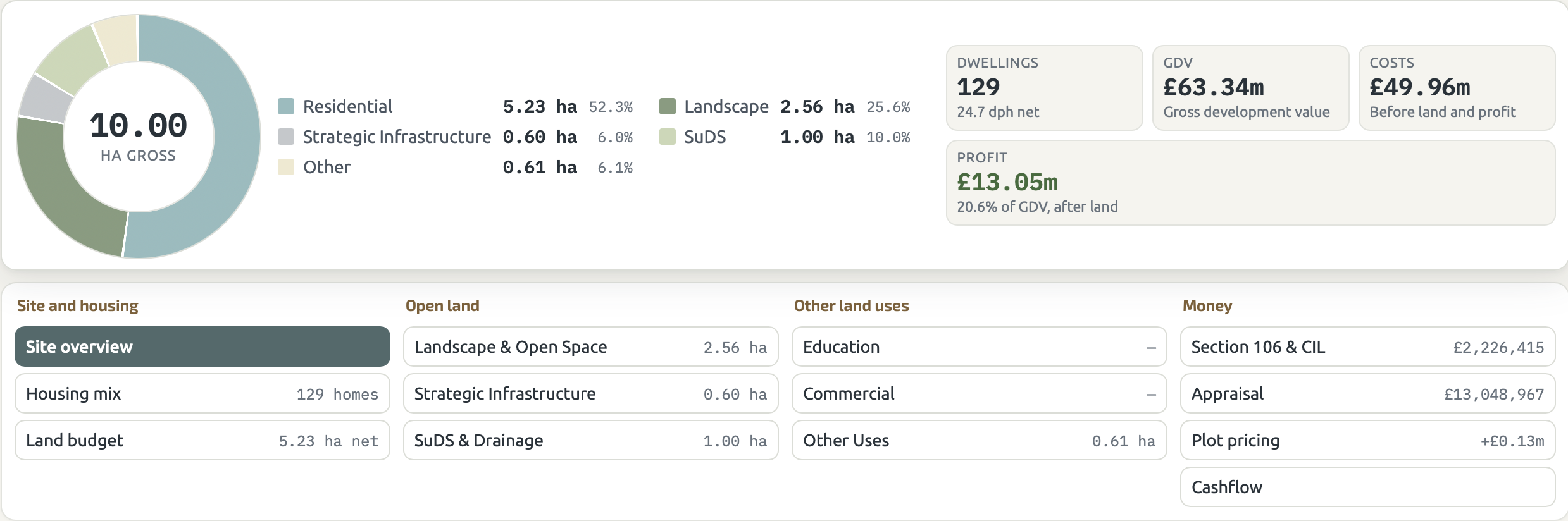
Feasibility
Should we pursue this site? Enter the site area, the council and a land price for a realistic capacity range and a straight answer on viability, in minutes.
Who it’s for:
Housebuilders, land agents and promoters, landowners, architects and landscape architects, town planners and local authorities.
Outline
What could we get permission for, and what is the land worth? Sourced local policy, Section 106 and CIL, your own house types and density tiles, and the land deal.
Detailed Design
What will the scheme cost, and what will it return? Measured costs, plot-by-plot pricing, open space management and a monthly cashflow
Why you need it:
Faster answers, lower costs, and accuracy from the start.
What are the benefits:
Decisions about land are made early, often before anyone has spent money on surveys or design. The Model gives a reliable answer at that first stage, and builds on it as the site moves forward.
Time saving
A first answer on any site in about five minutes, or twenty with your own figures. A complete Outline appraisal takes about a day, and a full Detailed Design about one to two days with a masterplan. There’s no spreadsheet to rebuild for each site, and capacity, policy, contributions, appraisal and cashflow all update together whenever a figure changes.
Cost saving
Find out whether a site works before paying for surveys, consultants or a layout, and walk away early from those that don’t. Check an asking price before you commit to it, see what the scheme can afford to pay for the land, and test what each extra contribution or change to the mix does to the profit before you negotiate.
Early Accuracy
Capacity comes from the character of the place and real house-type densities, not a rule of thumb across the whole site. On our demonstration site, a rule of thumb suggests 518 homes, while the site supports 202 to 223. Every policy figure is sourced, and every answer carries a confidence range that narrows as evidence replaces assumptions, so you always know how firm the figures are.